


Browse Similar Items
THE WONDERFULL WOORKMANSHIP OF THE WORLD: WHERIN IS CONTEINED AN EXCELLENT DISCOURSE OF CHRISTIAN NATURALL PHILOSOPHIE . . . SPECIALLY GATHERED OUT OF THE FOUNTAINES OF HOLY SCRIPTUR.
(London: [Printed by John Kingston] for Andrew Maunsell, 1578). 189 x 134 mm. (7 3/8 x 5 1/4"). [4], 87, [1] leaves (with foliation errors, but complete).Translated from the Latin by Thomas Twyne. First Edition in English.
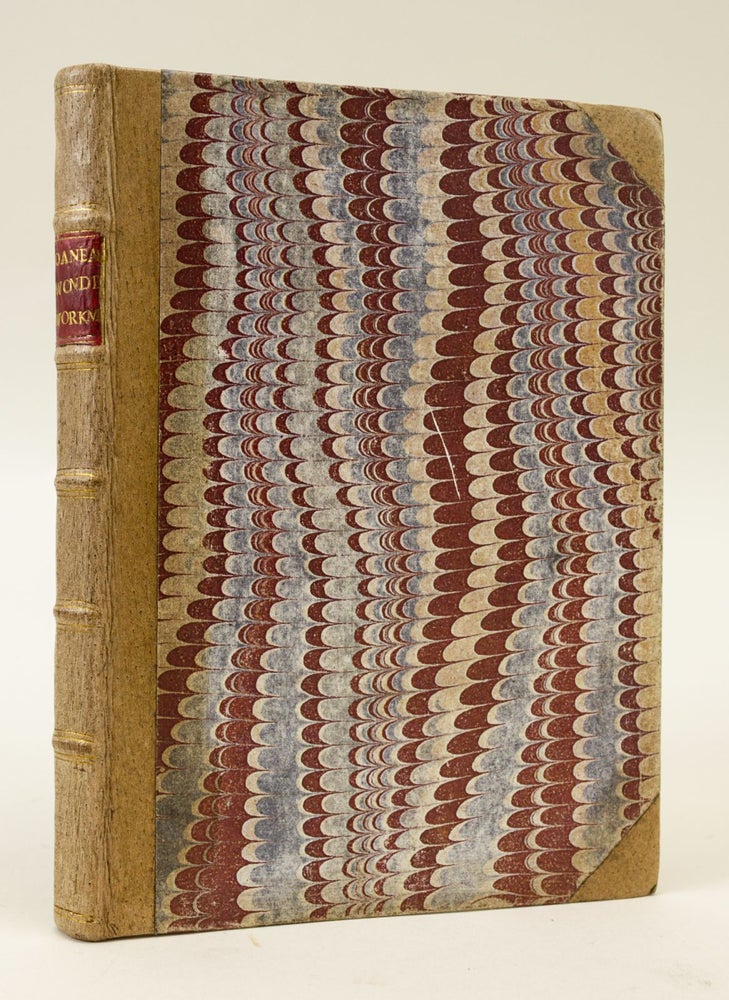
Retrospective half pigskin over marbled boards, raised bands, red morocco label. Title with woodcut ornament, head- and tailpieces, many decorative initials. Printed in black letter. Front pastedown with Macclesfield bookplate for the South library; title with inscription in ink "Dulcius ex ipso fonte bibuntur aquae" ["Sweetly the waters have been drunk from the fountain itself"] and with the initials "D. Fl." (see below); a couple of contemporary annotations in ink (one slightly shaved); numerous marginal readers' marks in ink and pencil. STC 6231; ESTC S105155. Paper a shade or two less than bright, title somewhat soiled, a dark stain affecting the upper corner of ff. 24-28 (touching text but all is legible); still, an overall very good, clean copy in a pleasing new binding.
This is the first appearance in English of Daneau's 1576 "Physica Christiana," the foundational work of "Mosaic physics," which attempted to reconcile the account of creation in Genesis with scientific knowledge of the natural world in order to create a "Christian natural philosophy." Though obviously theological in origin, "Christian Physics" is nevertheless substantially a work of natural history, generally adopting the Aristotelian worldview then prevalent. The first of two parts is a disquisition on creation, a long Socratic dialogue on the meaning of the opening chapters of Genesis. The second part, which occupies a good deal more than two-thirds of the volume, is a broader treatise on nature, including discussion of such things as light and shadow, meteors, the rainbow, thunder, precious stones, glass, gold, various trees, stars and planets, fish, birds, elephants, foxes, and many more topics. A Calvinist theologian forced into itinerancy because of his incautiously expressed opinions, Daneau (1530-95) produced a considerable number of books, mostly commentaries on the Bible and controversial works written against Lutherans and Catholics alike. Our copy has a couple of curious contemporary marginal annotations. On the verso of fo. 2, at the beginning of the second chapter, someone noted "Five / [s]peciall / [copie?]s of na- / [tu]rall phi- / [lo]sophye." And at the head of fo. 39 (mis-numbered 40] recto is the inscription "Sr. Walter Rawley Laureatus poeta May 4 anno reg. Eliz. 39 anno dom. 1598." There is nothing in Raleigh's biography that can account for his being mentioned as poet laureate in 1598; in that period, he was occupied in naval pursuits against the Spanish armada. It has been suggested that our copy was once owned by scholar and translator Andrew Hartwell (1553-1606), a bibliophile who sometimes used the Latin motto which appears on the title page here and who marked passages in his books with the floret-like squiggle seen here on ff. 3-12. At the same time, the "D. Fl." inscription on the title page resembles the ownership mark used by the celebrated 17th century bibliophile, antiquary politician, and magistrate Sir Daniel Fleming (1633-1701). Later, the book was securely located in the great library of the earls of Macclesfield, which was sold in 12 sales at Sotheby's (from 16 March, 2004, to 2 October, 2008) for some £22 million (at the time approximately $40 million). The library was dispersed when the 9th Earl Macclesfield, Richard Timothy George Mansfield Parker (b. 1943), who was described by the "Independent" as leading an "unconventional lifestyle," was forced to leave his 14th century Shirburn Castle after a protracted family dispute. Called by the paper "a sleeping beauty," his crenellated home had a moat, a drawbridge and, at the time of the Earl's departure, a repair bill of approximately £2.6 million. Despite the building's dilapidation, the books in the very large library were distinguished for being uniformly well preserved, were almost always in their original bindings, and were a sensation at auction for more than four years. The present work is rare: ABPC and RBH locate just one other copy at auction in the past 40 years. (ST15632)
Price: $8,500.00