


Browse Similar Items
RELIGIO MEDICI, URN BURIAL, CHRISTIAN MORALS, AND OTHER ESSAYS.
(London: Vale Press, 1902). 298 x 203 mm. (11 3/4 x 8"). cxcviii pp, [1] leaf (colophon). ONE OF 310 COPIES (an additional 10 copies were printed on vellum).
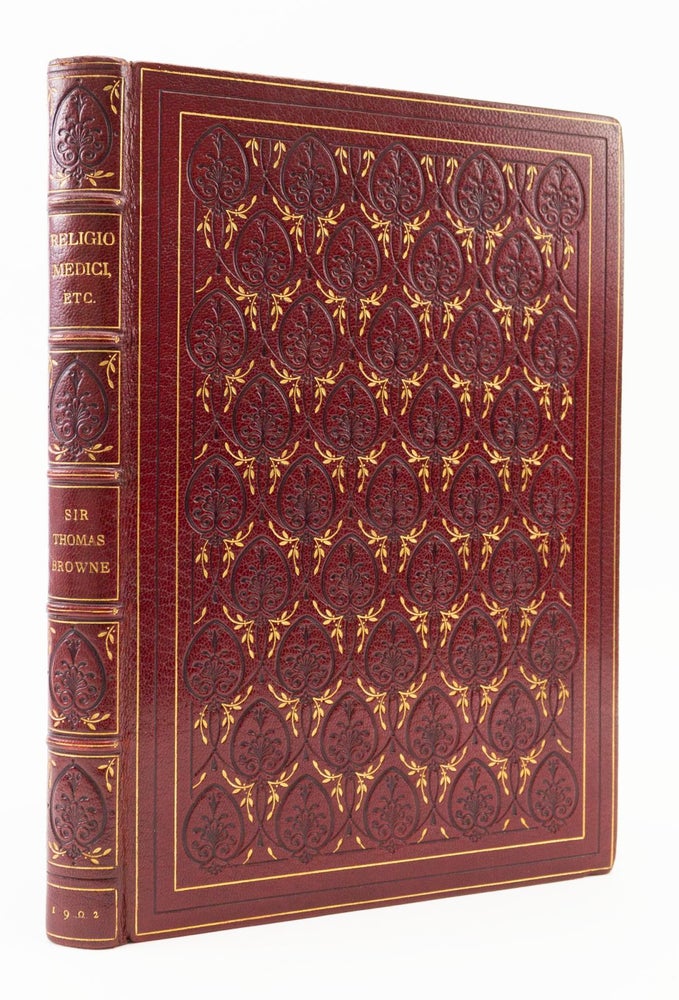
VERY HANDSOME MAROON CRUSHED MOROCCO BY ZAEHNSDORF (signed on front turn-in and stamped on rear pastedown), covers with center panel of blind-stamped palmettes and festoons in staggered rows, gilt foliate sprays at convergence points, raised bands, spine compartments with blind-stamped palmette centerpiece and gilt leaf sprigs at corners, maroon silk endpapers, top edge gilt, other edges untrimmed. Woodcut vine border by C. S. Ricketts on first text page. Van Capelleveen A 73a; Tomkinson, p.170. Lower corners a little dented, light foxing resembling a fine spray in many lower margins, occasionally spreading upwards, (probably resulting from the printing process), but certainly a fresh copy in a lustrous binding with only minor signs of use.
This stately printing of one of Browne's most celebrated and enduring writings is perhaps the most attractive major work Ricketts attempted at the Vale Press, and our copy is offered in a pleasing (and appropriate) binding by a preeminent London firm. The Oxford Companion describes "Religio Medici" as "a confession of Christian faith (qualified by an eclectic and generally skeptical attitude), and a collection of opinions on a vast number of subjects more or less connected with religion, expressed with a wealth of fancy and wide erudition." Readers have always been fascinated by the book's style, by the mind that both style and contents reveal, and by the author's combination of detachment from the world and curiosity about its smallest physical objects. Browne says in his preface that the book was written for his "private exercise and satisfaction," but he was not repelled by its unauthorized publication in 1642, nor did he discourage its republication a year later. It is accompanied here by other pieces, including "Hydriotaphia: Urn Burial," one of the first archaeological monographs in English. Physician and writer Sir Thomas Browne (1605-82) was one of the great 17th century stylists of English prose, and one of the most innovative thinkers of his time. The Vale Press books, which Cave says were "far truer to the spirit of fifteenth-century printing than Kelmscott work," included nearly 50 titles issued during the eight-year life of the press, and both its impressive output and considerable artistic success can be attributed to the fact that Ricketts, who was remarkably skilled as a designer, painter, and illustrator, was in control of every facet of the operation. Our binding is a fine example of the work of the Zaehnsdorf firm, long a top-ranked English bindery. Born in Pest, Hungary, Joseph Zaehnsdorf (1816-86) served his apprenticeship in Stuttgart, worked at a number of European locations as a journeyman, and then settled in London, where he was hired first by Westley and then by Mackenzie before opening his own workshop in 1842. His son and namesake took over the business at age 33, when the senior Joseph died, and the firm flourished under the son's leadership, becoming a leading West End bindery. Over the years, Zaehnsdorf employed a considerable number of distinguished binders, including the Frenchman Louis Genth (who was chief finisher from 1859-84), and trained a number of others, including Roger de Coverly and Sarah Prideaux. A family-run business until 1947, the Zaehnsdorf bindery continued to produce consistently attractive and innovative designs executed with unfailing skill. (ST17640n)
Price: $2,500.00