
Browse Similar Items
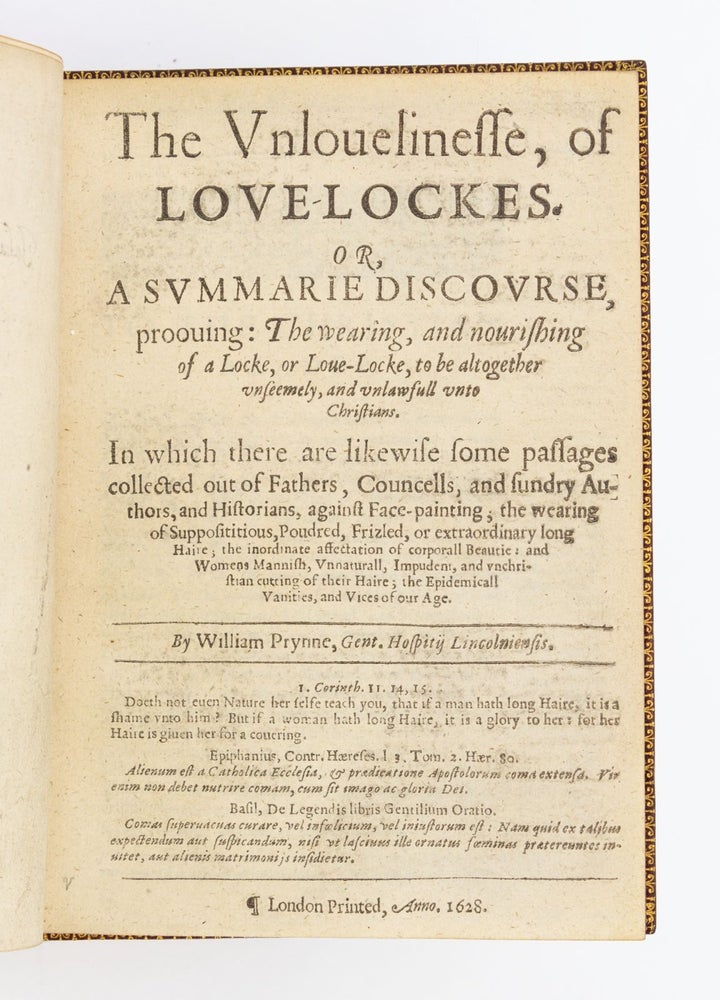
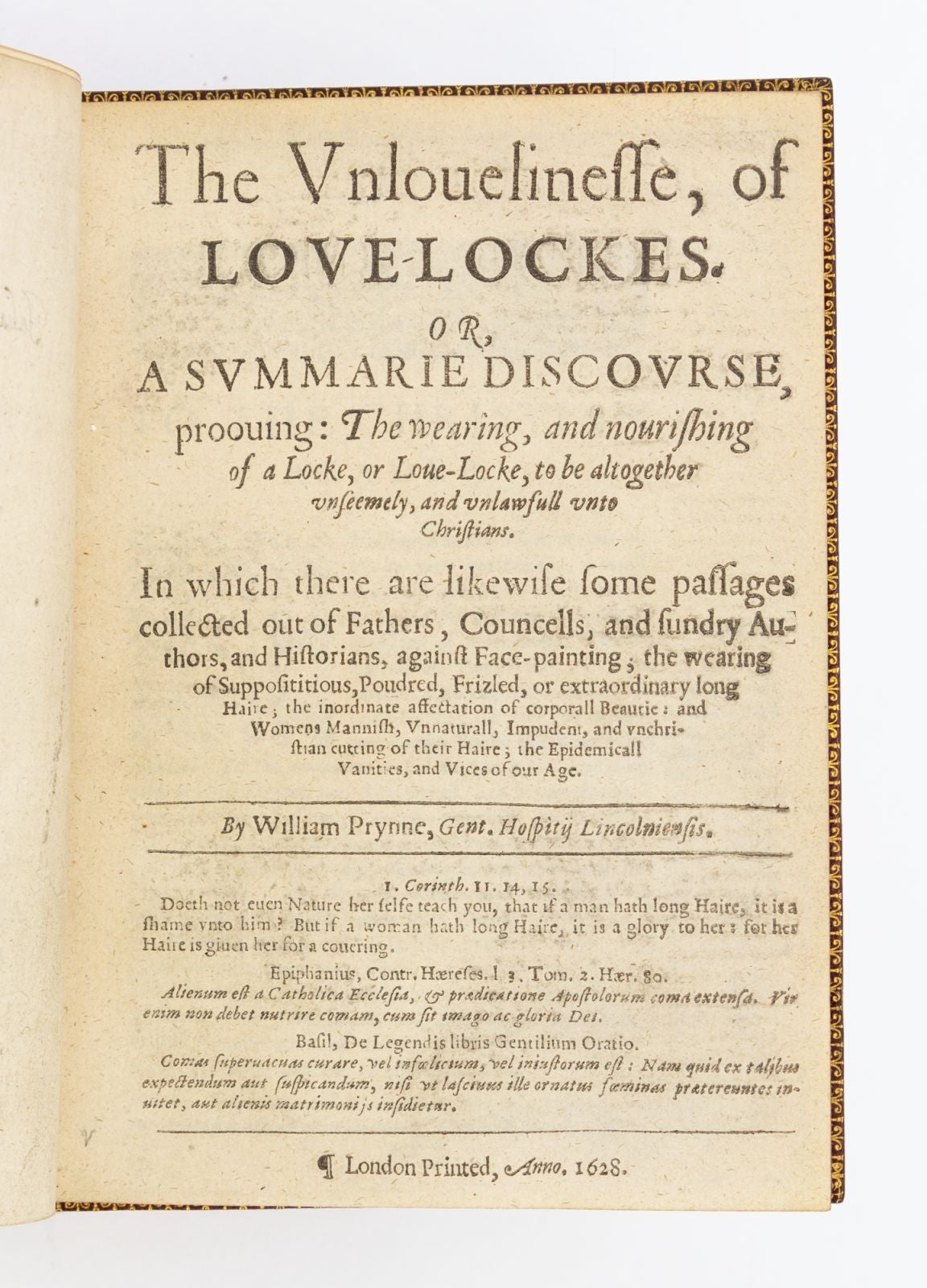
THE UNLOVELINESSE, OF LOVE-LOCKES. OR, A SUMMARIE DISCOURSE, PROOVING: THE WEARING, AND NOURISHING OF A LOCKE, OR LOVE-LOCKE, TO BE ALTOGETHER UNSEEMLY, AND UNLAWFULL UNTO CHRISTIANS.
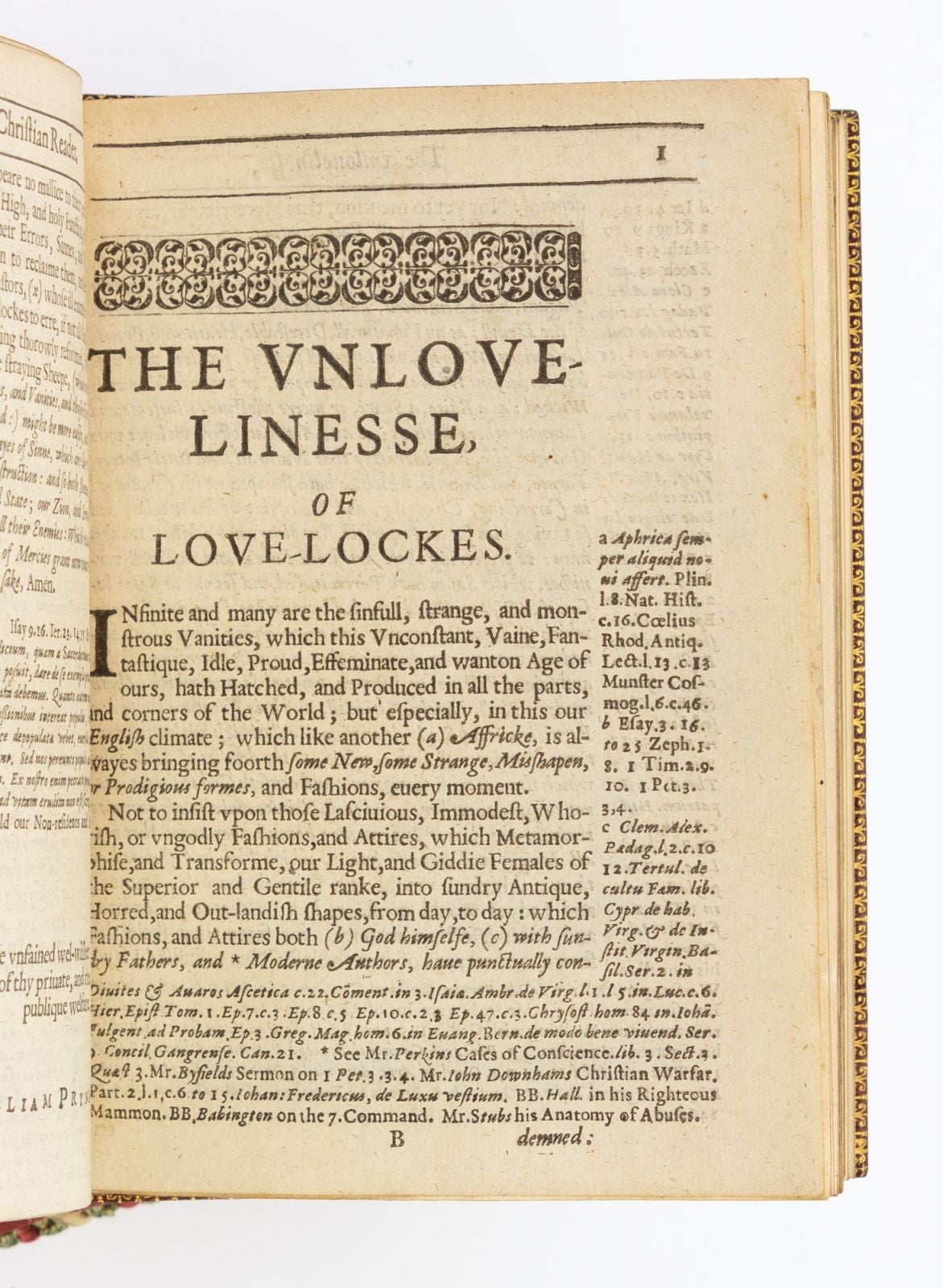
(London: n.p., 1628). 184 x 137 mm. (7 1/4 x 5 3/8"). 12 p.l. (including the initial blank), 63, [1] pp. (pp. 41-48 misnumbered 33-40). FIRST EDITION (the issue with "needes" in the second line on D2).
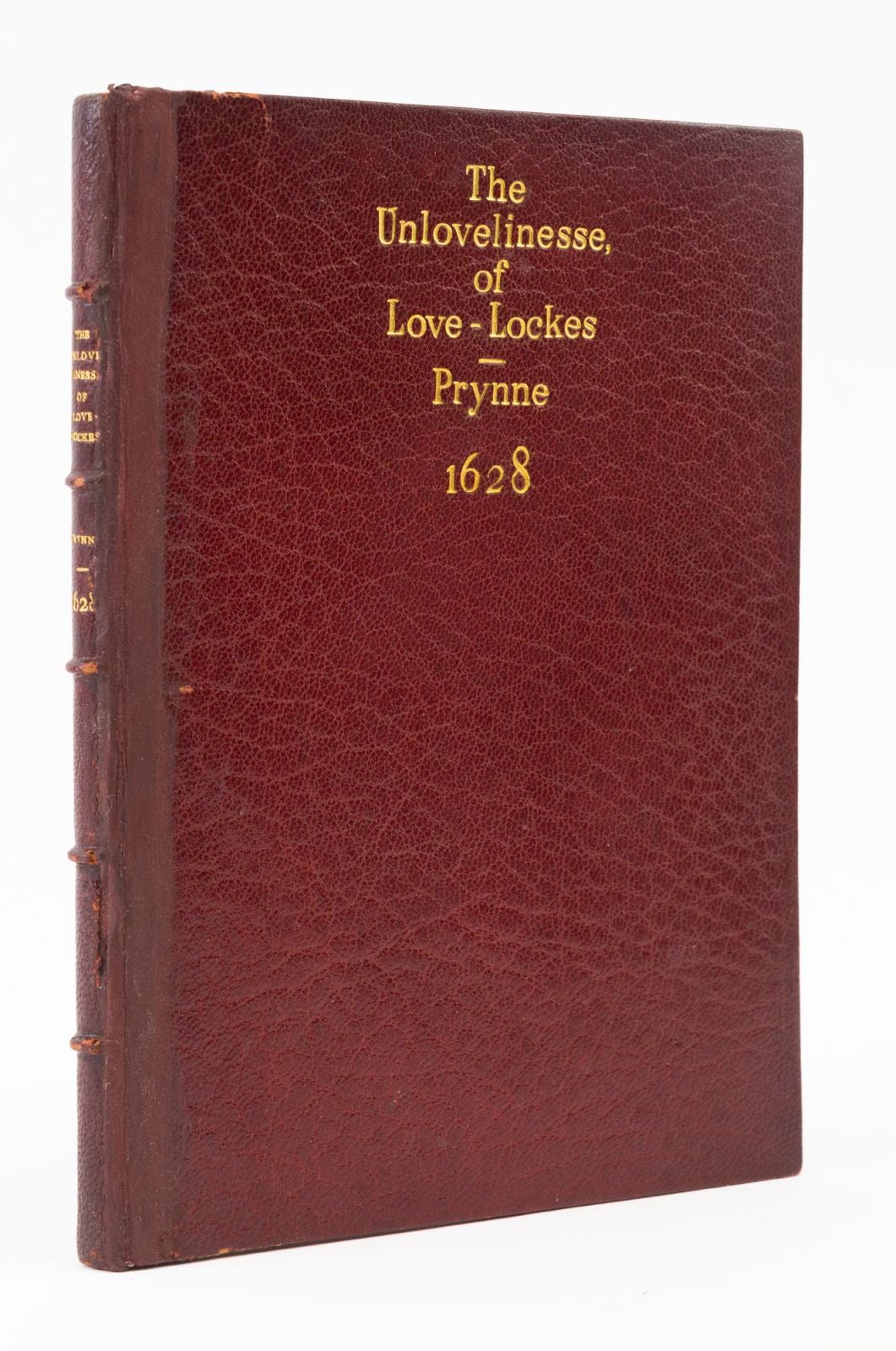
Red crushed morocco by Riviere (stamp-signed on front turn-in), title and date on front cover, raised bands, titling in two spine panels, gilt edges (front joint rather noticeably repaired). In a custom-made folding cloth box with leather label and fleece lining. Front pastedown with book label of Arbury Library; blank with contemporary inscription of Julian Leigh (see below for both). STC 20477; ESTC S115447. Rear joint cracked (with consequent slight looseness), leaves probably washed and resized because extremely fresh and at the same time a shade less than white.
This is an early work by the Puritan lawyer and indefatigable pamphleteer William Prynne (1600-69), who had a very great deal of advice, mostly unsolicited and unwelcomed, for the fair sex. In the text here he rails against many things, including "face-painting; the wearing of supposititious, poudred, frizled, or extraordinary long haire; the inordinate affectation of corporall beautie; and womens mannish, unaturall, impudent and unchristian cutting of their haire." While the work can be viewed as a moral diatribe, to us it is illuminating as social history, talking as it does about the dress and grooming of persons of quality and the responses these evoked in the first half of the 17th century. Prynne graduated from Oriel College, Oxford, in 1621, became a student at Lincoln's Inn, and before long began producing pamphlets that occupy more than 250 entries in STC and Wing. Our work is a forerunner to one of his most infamous and ill-timed works, "Historio-mastix," in which he vigorously denounced female actors appearing on the stage--at the same moment Queen Henrietta Maria was preparing a masque to present at court. This misstep led to a conviction for sedition, and his sentence included a £5,000 fine, life imprisonment, and the removal of his ears. His later pamphlets were not noticeably less inflammatory, and these led to a further sedition charge as well as more disfigurement (including a slit nose and a brand on his cheek announcing him as a seditious liar). Our copy is recorded as lot #271 of Sotheby’s "Catalogue of Rare and Valuable Books Selected from the Ancient & Celebrated Library at Arbury Hall, Warwickshire, the Property of Sir Francis Newdigate-Newdegate" (1920). The earliest recorded owner, however, is an ancestor of Sir Francis: the 17th century gentlewoman whose name is variously given as Juliana or Julian Leigh (bap. 1610, d. 1685). She was the daughter of Sir Francis Leigh of Newnham Regis, Warwickshire, and the granddaughter of Thomas Egerton, Viscount Brackley, who was Lord High Chancellor of England. In 1632, she married Sir Richard Newdigate, 1st Baronet (1602-1678) of Arbury Hall, who became Lord Chief Justice. Notably, Newdigate was an exact contemporary of Prynne at Oxford, and they were both admitted to the bar in 1628, the year our "Love-Lockes" was printed. It is certain that Newdigate and Prynne were well acquainted, as together, on behalf of the crown, they famously prosecuted leaders of the Irish rebellion in 1644 and 1645, resulting in multiple executions for high treason. (ST17855)
Price: $1,800.00