


Browse Similar Items
OPUS MERLINI COCAII POETAE MANTUANI MACARONICORUM.
(Amsterdam: Apud Abrahamum à Someren, 1692). 155 x 95 mm. (6 1/8 x 3 3/4"). 16 p.l., 419, [5] pp.
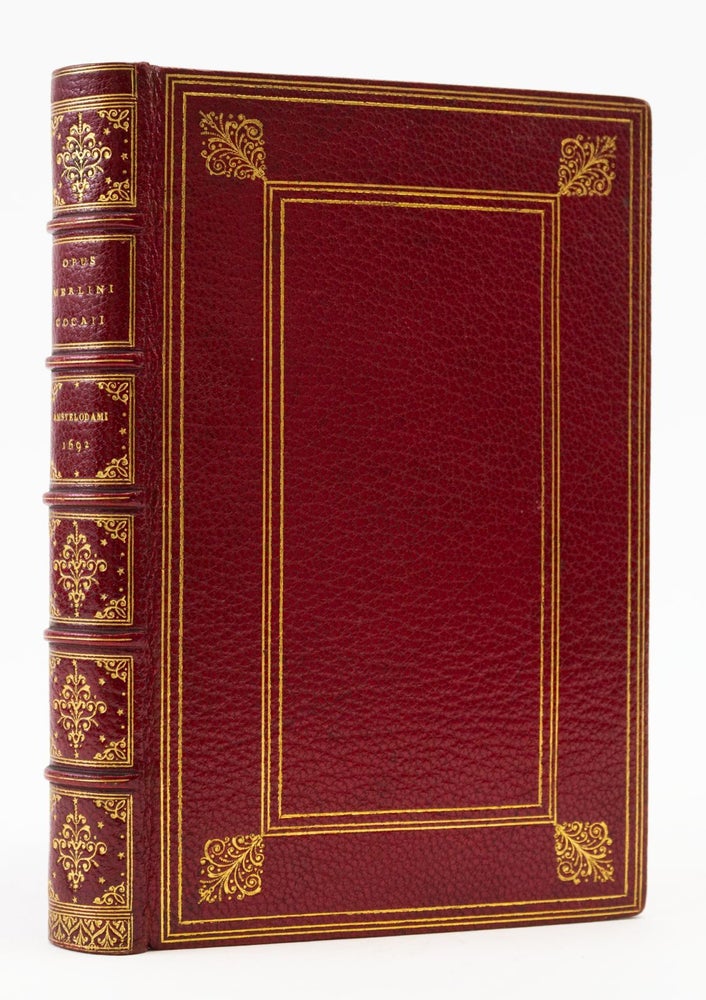
VERY ATTRACTIVE 19TH CENTURY RED CRUSHED MOROCCO, GILT, BY ISIDORE SMEERS (stamp-signed on verso of front free endpaper) covers with French fillet frame, oblique fleurons at corners, raised bands, spine compartments with central fleuron, curling cornerpieces, gilt lettering, densely gilt turn-ins, marbled endpapers, all edges gilt over marbling. With frontispiece portrait of the author, decorative woodcut initials and tailpieces, and 26 engraved vignettes. Front pastedown with engraved bookplate of Dr. Felix Durosier (see below). Text probably (and, if so, gently) washed and pressed (as was the bibliophilic fashion at the time of binding), isolated faint marginal smudges, but a very fine copy--clean, fresh, and bright internally, in an extremely lustrous binding with virtually no signs of wear.
This is a collection of works by one of the principal practitioners of Italian macaronic verse, adorned with entertaining engravings and in an appealing binding by a leading Parisian workshop. A wayward Benedictine monk who left the monastic life for a decade, Folengo (1491-1544) wrote—under the pseudonym Merlinus Cocaius or Merlino Cocajo—macaronic verse, a form of literary burlesque in which Latin is combined with vernacular Italian words given Latinized endings to comic effect. It takes its name from the maccarona dumplings eaten by peasants in the 16th century. First printed in 1517, Folengo's "Phantasiae Macaronicon" contains 25 "macaroni," or cantos, involving the fictitious hero Baldus. The book is full of coarse buffoonery but is "often relieved by touches of genuine poetry, as well as by graphic descriptions and acute criticisms of men and manners." (Britannica) Each of the macaroni here is illustrated with an engraving depicting the adventures of Baldus, from sea battles to dungeon to the fires of Hades. A satire on chivalric poetry and Virgilian epics, the poem helped to liberate Italian literature from the stultifying influences of the court and the Tuscan dialect. Britannica notes that the work "attained a wide popularity" and was "quoted and still more frequently copied by Rabelais." The other works here are "Zanitonella," a parody of Petrarchan love poems, and the "Moschaea," a mock-heroic poem celebrating the victory of ants over flies. Our copy was bound by Isidore Smeers (1834-96), a Belgian who spent his career (1865-90) in Paris, where he was among the leading binders of the day, and did a great deal of work for the publishing house of Firmin-Didot. This volume is from the library of the distinguished 19th century French bibliophile and physician Félix Durosier of Cognac, near Bordeaux. The design of his armorial bookplate was drawn by the esteemed painter, illustrator, and engraver Antoine Duplais-Destouches (1860-1900), and depicts the family coat of arms superimposed, appropriately, over the foliage of a rosebush ("du rosier" being French for rosebush). (ST18236)
Price: $2,900.00