


Browse Similar Items
SHAKESPEARE ON ENGLAND.
(Sheffield, England: December 1944). 265 x 215 mm. (10 1/2 x 8 1/2"). [6] leaves illuminated on rectos, (final leaf also illuminated on verso, with colophon).
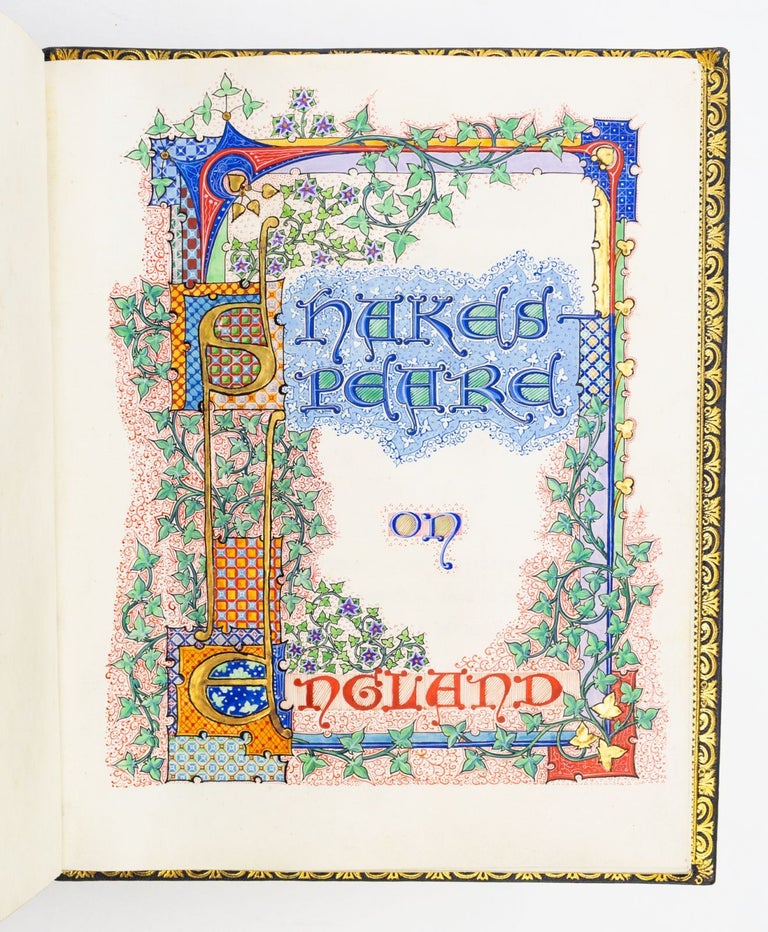
VERY ATTRACTIVE DARK BLUE MOROCCO, GILT, (stamped-signed "Bound by Slinn" on front pastedown), upper cover with monogram of Edwin Goddard Stokes framed by gilt-ruled compartments containing gilt lettering, elaborate gilt foliage, and a gilt crown tool at top, the panel surrounded by a double gilt rule frame and dogtooth roll border with additional foliate tools, rear cover with quatrefoil design in floral tools and pointillé, dogtooth roll border, smooth spine with gilt-ruled compartments. In a rather worn felt-lined brown paper wallet case with handwritten titling on spine. Each recto with one or two large two- to three-line initials either painted or gilt, TITLE PAGE WITH A FULL BORDER and others with a large complex border, all of them elaborately painted with a variety of patterns, styles, motifs, and with gilt embellishments, one border incorporating three coats of arms, AND ANOTHER PAGE WITH A QUARTER-PAGE MINIATURE OF A KNIGHT ON HORSEBACK. Trivial wear at top of front joint, otherwise in pristine condition.
This is a charming modern illuminated manuscript penned during WWII that contains two excerpts from Shakespeare in praise of "this other Eden, demi-paradise" called England--specifically, passages from John of Gaunt's dying speech in "King Richard II," and lines from "King John." As stated in the colophon, the manuscript "was Designed, Written out and Illuminated by John Wilfred Clarke of Ecclesall, Sheffield, for his great friend Edwin Goddard Stokes of Ringinglow, Sheffield." Clarke (d. 1954), was a municipal engineer and town planner by trade, professions for which skill in the visual arts, particularly draftsmanship, is not only preferred, but required. He was clearly a talented amateur with a flair for pattern and design. Though he incorporates elements found in Medieval manuscripts--trailing ivy leaves, penwork decoration, tessellation, and line enders--the style is at the same time modern, utilizing bold color combinations and layered shapes and patterns. Given the artist's location, it is quite possible that he was involved with the Sheffield School of Art, which was founded in 1843 and offered classes in fine arts and crafts. We know that the binder, Walter Slinn (d. 1964), was a staff member at the school as well as a prominent local bookbinder. Nationalistic sentiments are made clear in the choice of material celebrating England in Shakespeare's voice, and this manuscript is all the more poignant when seen in the context of its time and place. Sheffield, an industrial city, was a major producer of steel and armaments during WWII --and thus a high-value target for German air raids. (The so-called "Sheffield Blitz" of 1940 resulted in hundreds of deaths and nearly 80,000 damaged homes.) In December of 1944, when this manuscript was completed, the end of the war was not yet in sight. Despite the bleak circumstances, the manuscript radiates color, light, and hope. The recipient of Clarke’s attractive manuscript was Edwin Goddard Stokes (1902 - ca. 1957), one of the sons of the prominent Sheffield businessman Robert James Stokes, founder of R. J. Stokes & Co., a tile company that still flourishes in the city now. It is clear that this item was carefully looked after by this "great friend" of the artist. So far as we have been able to determine, Clarke is an unrecorded artist except for the present Shakespeare work and one other similar manuscript, featuring excerpts from Chaucer (now in Stanford University Library). (ST19310)
Price: $7,500.00