


Browse Similar Items
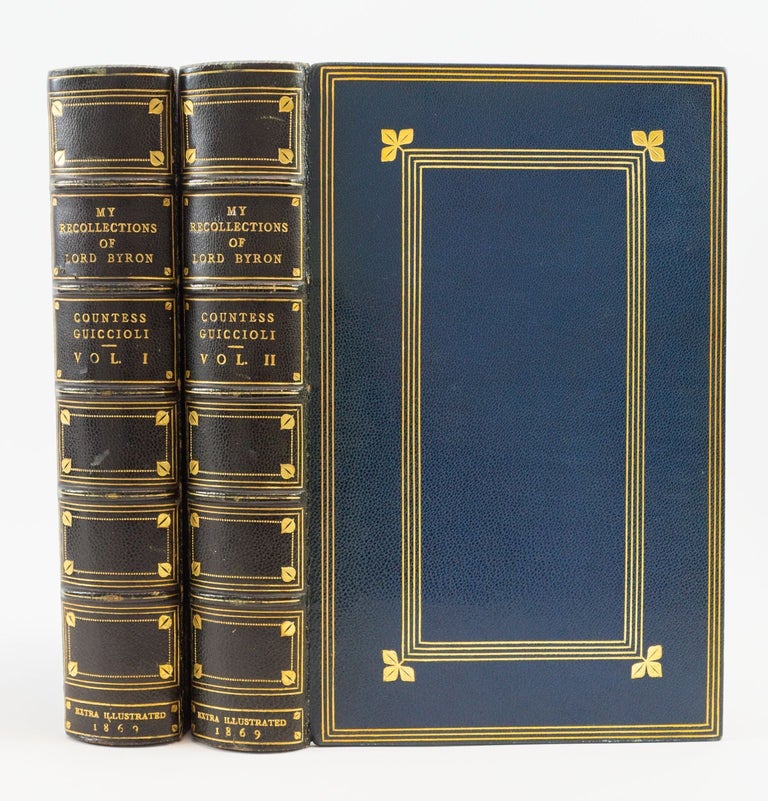
MY RECOLLECTIONS OF LORD BYRON; AND THOSE OF EYE-WITNESSES OF HIS LIFE. Translation of LORD BYRON JUGÉ PAR LES TÉMOINS DE SA VIE.
(London: Richard Bentley, 1869). 225 x 140 mm. (8 7/8 x 5 1/2"). Two volumes. Translated and edited by Hubert E. H. Jerningham. First Edition in English.
Attractive navy blue crushed morocco, gilt, by Root & Son for Charles Lauriat of Boston, covers framed by multiple gilt fillets, oblique trefoils at corners, raised bands, spine compartments similarly framed, gilt lettering, turn-ins framed with gilt rules and dots, floral sprays at corners, marbled endpapers, top edge gilt. The two volumes housed together in a fleece-lined blue buckram slipcase. First volume with portrait frontispiece of the poet, EXTRA ILLUSTRATED WITH 49 ENGRAVINGS with tissue guards, 37 of these portraits of friends, lovers, and fellow poets, 12 views of locations important in Byron's life. Front pastedowns with engraved armorial bookplate of Charles Everett. ◆Spines evenly darkened, front joint of first volume a bit rubbed, other trivial wear, isolated minor foxing, but a pleasing set, especially bright, clean, and fresh internally.
Tastefully bound and lavishly illustrated with pictures of the people and places discussed in the text, this is the first appearance in English of the reminiscences of Byron's Italian mistress, who lived with him in the final years of his life. First published anonymously in French in 1868, it is the work of Teresa, Countess Guiccioli (1800-73), who met Byron in 1818, just days after marrying a powerful diplomat 50 years her senior. By 1819, Teresa was living with Byron, and they stayed together until he departed to fight in the Greek war of independence in 1823; her brother, Pietro Gamba, accompanied the poet on his final journey. Teresa's aim in the present text is to show a less scandalous, more human side to Byron--who by the time of this printing was more identified with his greatest creation, Don Juan. Her anecdotes highlight his generosity, courage, and loyalty to friends, while acknowledging the vanity, arrogance, and misanthropy of his darker moods. The London bindery of William Root & Son consistently produced excellent work, both on fine bindings like the present set and on trade bindings of multi-volume works. Packer lists the firm in business in Red Lion Square in 1899-1901, and the December 1942 issue of "The Rotarian" notes with regret that Root had been bombed out of their premises on Paternoster Row during the 1941 Blitz. (ST19520b)
Price: $1,800.00