


Browse Similar Items
THE WORKS.
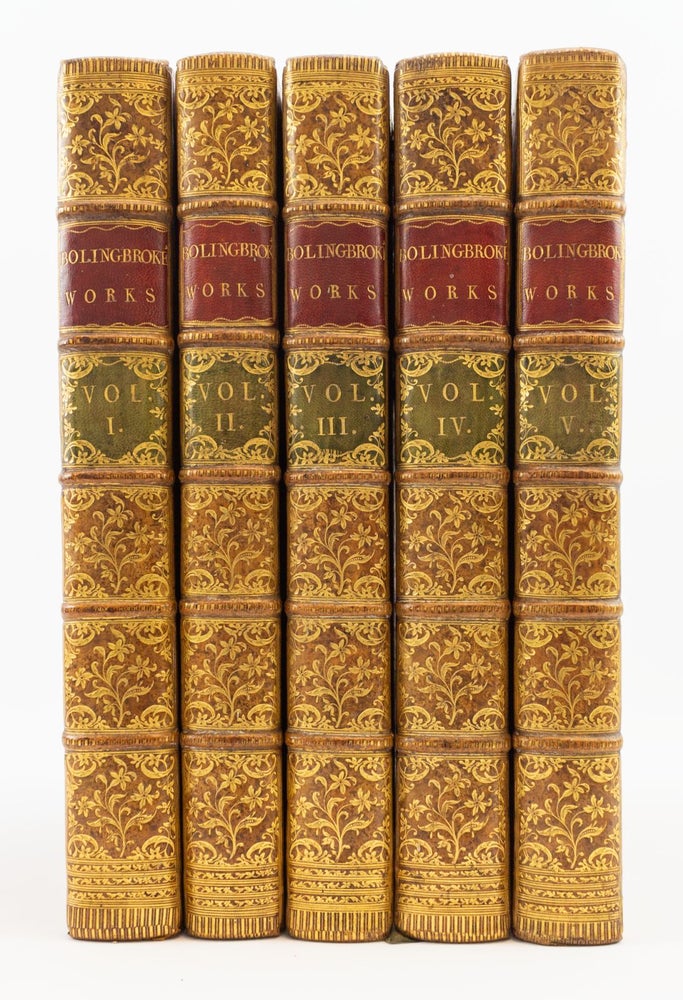
(London: David Mallet, 1777). 308 x 238 mm. (12 x 9 1/4"). Five volumes.
IMPRESSIVE CONTEMPORARY TREE CALF, covers with gilt-rule border, raised bands, spines elegantly gilt in compartments with floral sprays at center and in corners, one red and one green morocco label, gilt-rolled turn-ins, marbled endpapers. With frontispiece portrait. Front pastedowns with engraved armorial bookplate of Merthyr Guest. ESTC T139449; Day, "History of English Literature 1660-1837," pp. 116-17. Three abrasions (one the size and shape of a little finger, all refurbished, though still noticeable), wear of not great importance to extremities (mainly lower corners), a few minor nicks or abrasions to the leather, trivial browning or marginal smudges in the text, but still AN EXTREMELY ATTRACTIVE SET on the shelf, REMARKABLY CLEAN, SMOOTH, AND FRESH INTERNALLY, with spacious margins, and with bindings that are lustrous and that feature especially attractive spines.
This is a very handsomely bound large format set of writings by the dashing and eloquent Bolingbroke (1678-1751), focusing primarily on English history and political philosophy, but also including his letters to his friend Alexander Pope. Early in his public life, Bolingbroke was famous as a Restoration rake who was said to have been seen sprinting through a communal space intoxicated and in the nude. But after his life took a more sobering turn, he entered the government of Queen Anne as a Tory and was instrumental in the peace negotiations with France that ended the wars of Louis XIV. And when considered as a whole, his body of writings must be seen as the work of one of the great political thinkers of his era. According to Day, his political philosophy "rejected the divine right of kings and admitted the premise of the Bloodless Revolution, that the will of the people shall govern the nation. . . . He proposed the elimination of party and the strengthening of a truly representative Parliament through a broad franchise." And "in his proposals for a disinterested survey of history, he has been called the first Englishman truly to sense the continuity of history and to observe contemporary events as workings of fundamental human conflicts paralleling the past and developing out of it." But Bolingbroke's reputation among his contemporaries was damaged by shady financial dealings, dissolute ways, and vicious attacks on his opponents, all of which led to his writings being dismissed or overlooked for many years after his death. DNB observes that modern scholars view him as "a substantial, if flawed, political figure in Anne's reign and as a brilliant, if eventually unsuccessful, political writer in the age of Walpole. . . . Bolingbroke's writings tell us much about the ideological divisions that persisted under the first two Hanoverian monarchs. Although he lacked good sense and political judgement, Bolingbroke was widely read, wrote well, and did make a sincere effort to provide the disparate elements of the parliamentary opposition with a coherent political ideology and a moral platform." As one would expect, this tall, attractive set comes from a gentleman's library, that of Thomas Merthyr Guest (1838-1904), a retired army major and justice of the peace who came from a distinguished Welsh family that made their fortune in iron and steel works. His wife was the writer and philanthropist Lady Theodora Grosvenor Guest (1840-1924), daughter of the second Marquess of Westminster. (ST19522b)
Price: $2,250.00