


Browse Similar Items
RUBAIYAT OF OMAR KHAYYAM.
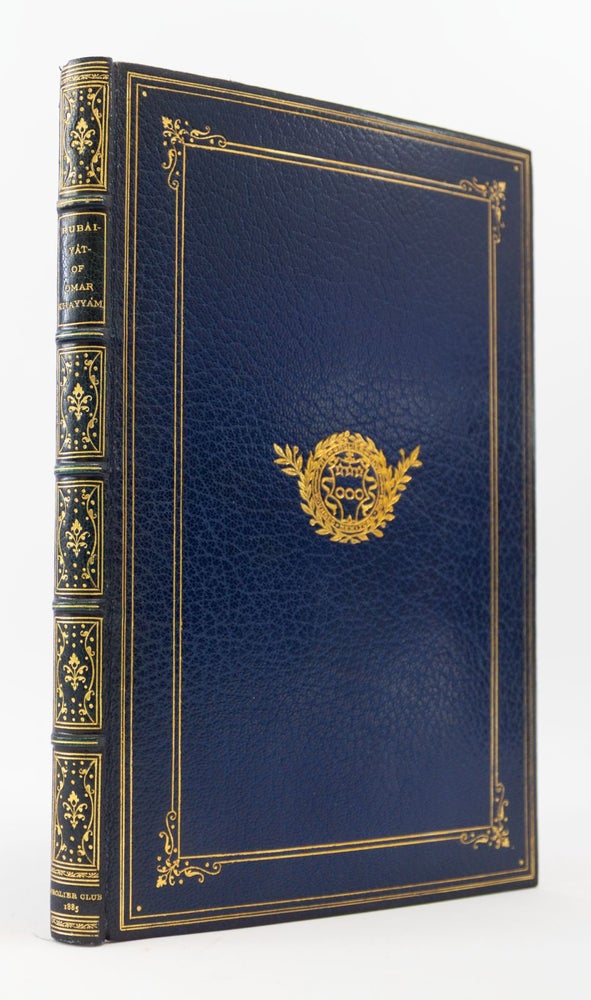
(New York: The Grolier Club, 1885). 235 x 155 mm. (9 1/4 x 6 1/8"). xx, [ii], 62 pp., [1] leaf.Edward FitzGerald. No. 137 OF 150 COPIES.
HANDSOME BLUE CRUSHED MOROCCO, GILT, BY BRADSTREET (stamp-signed in gilt on front turn-in), covers with the Grolier Club emblem surrounded by a wreath, gilt-ruled panel with foliate cornerpieces, French fillet border, raised bands, compartments each with a floral device flanked by two vines and surrounded by gilt dots, gilt lettering, gilt-ruled and rolled turn-ins with foliate decorations in each corner and along each edge, textured endleaves, top edge gilt (others plain). Original decorative paper wrappers bound in. With color emblem of Grolier Club on title, and three large color headpieces in the Moorish style after Owen Jones. Printed on Japon. Front pastedown with bookplate of Samuel F. Barger. Potter 211. Small patch of loss to front textured endpaper (from bookplate removal?), otherwise a lovely book in exemplary condition.
This is a handsomely bound copy of a desirable limited edition of a work generally recognized as the most important poem of the Victorian era. Son of a wealthy Irish landowner, FitzGerald (1809-83) had enough money to pursue a rather desultory literary career as a "genteel gipsy" (in Terhune's words) before beginning to study languages in middle age. He started his translation of the quatrains ("rubáiyát" in Persian) attributed to "Umar Khayyam" in 1856; according to DNB, about half of FitzGerald's final work paraphrases (rather than directly translates) portions of the 11th century poem, while the rest is original verse inspired by Omar. "The result is generally seen as being in some ways an original English poem, one that is much better known than Omar's poem is in Persian." (DNB) It certainly earned FitzGerald "a prominent place among the immortals of English literature" in Jewett's opinion. In 1858, FitzGerald submitted 25 of the "less wicked" verses to "Fraser's Magazine" only to be rejected. He had 250 copies published, anonymously, at his own expense, but had no luck selling them. Admitting defeat, he gave 200 copies to Quaritch; these sold so poorly that they were relegated to the penny bin, where Potter says they were discovered--and soon celebrated--by Dante Gabriel Rossetti and Algernon Swinburne. Those copies that remained unsold when Quaritch moved to Piccadilly in 1860 were either lost or destroyed, but by 1861, Rossetti and his Pre-Raphaelite brethren, along with Celtic scholar Whitley Stokes, were evangelizing for the work, embracing the lush, lyrical verse that would move English poetry away from Victorian orthodoxy and convention.
Bradstreet ranked with Stikeman as one of the leading binderies in turn-of-the-century New York. In his "Historical Essay on the Art of Bookbinding," Henri Pène du Bois notes that "there is a solidity, strength and squareness of workmanship about the books of the Bradstreet bindery which seem to convince that they may be tossed" from the summit of a mountain "without detriment or serious injury." Certainly our volume is a testament to the durability of Bradstreet bindings: after nearly a century and a half, it shows virtually no evidence of wear. This copy comes from the library of lawyer and railroad financier Samuel F. Barger (1832-1914), a longtime director of Cornelius Vanderbilt's New York Central Railroad. (ST19567-035)
Price: $3,500.00 save 50% $1,750.00