


Browse Similar Items
C'EST D'AUCASSIN ET DE NICOLETE.
(Hammersmith: Eragny Press, 1903). 221 x 150 mm. (8 3/4 x 5 7/8"). 1 p.l., 3-55, [3] pp. ONE OF 230 COPIES.
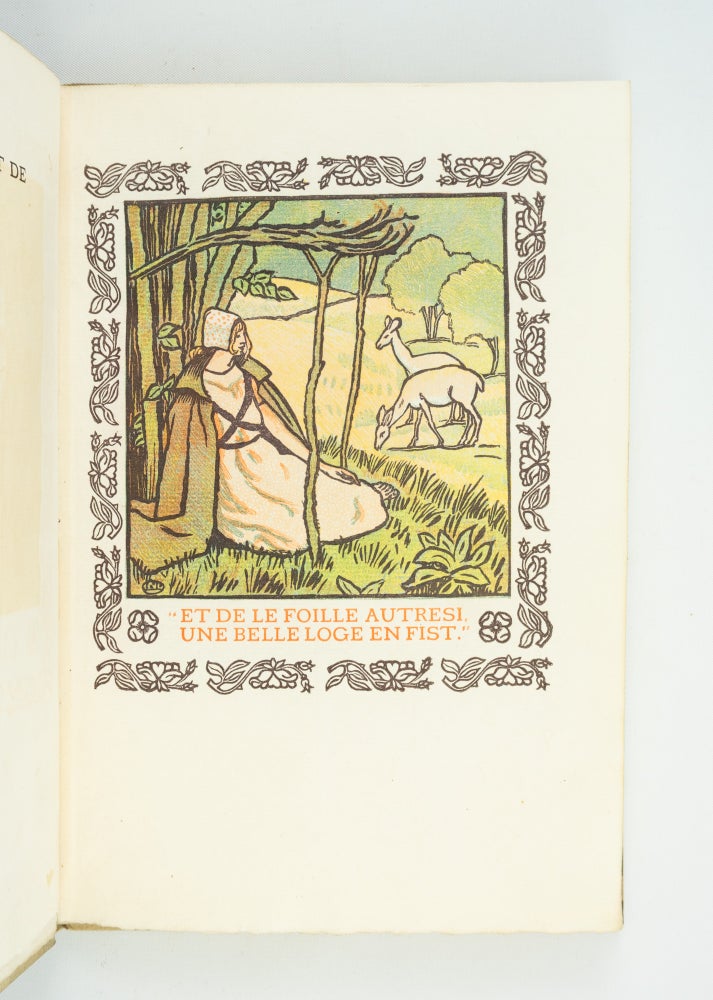
Publisher's quarter buff paper over boards covered with patterned floral paper, gilt lettering on upper cover, smooth spine with two gilt floral tools, edges untrimmed. With woodcut frontispiece printed in colors, and woodcut printer's device. Printed in red and black. Front pastedown with the "W R H J" scorpion bookplate of Wynne Rice Hugh Jeudwine. Tomkinson, p. 64; Ransom, p. 262; Urbanelli, p. 122. Spine very lightly toned and with a small snag, a hint of soiling to front cover, offsetting to endleaves (as nearly always) and on the leaf on either side of the frontispiece, a couple negligible spots internally, otherwise contents pristine.
Printed at what has been considered the apex of the Eragny Press's production, this is an excellent copy of a work exemplifying Pissarro's characteristic blend of English and French influences, mediated by his own strong artistic sentiment. Operated between 1894 and World War I by Lucien and Esther Pissarro, the Eragny Press produced charming books of the highest quality but in design unlike the other major private presses at work in England. The delicately colored wood engravings, the typical patterned paper bindings, and in general the inclination to be fresh and pretty rather than elegant, grand, or luxuriant gave this press a distinctive place in the movement. Lucien, who studied art under his father, the Impressionist painter Camille Pissarro, came to England hoping to get his woodcuts published and looking for an opportunity to make lovely books, two goals that were accomplished with the help of Charles Ricketts, the founder of the Vale Press, who shared his newly created Vale Type with Pissarro. This was the final work printed in the Vale type at Eragny press, since the Vale Press closed that year and their types were destroyed. The attractive type is interspersed with printed musical notation and oak leaf paragraph markers, and the volume features a characteristically striking frontispiece with wonderfully delicate color work. The text is taken from an anonymous late 13th century Provençal "chante-fable" (prose and song narrative) full of forbidden love and adventure, part of it fantastical. Known from only one surviving manuscript, the story centers around the title characters, an aristocratic son of a count and the object of his love, a beautiful Saracen slave. After having their affections blocked, the lovers escape to embark upon several adventures, one occurring in the exotic land of Torelore, where the king is about to give birth and the queen is commanding troops in a war fought with cheese and fruit. Printed in the original French but with strong influences of the English Pre-Raphaelite and Arts & Crafts movements, this is representative of what Urbanelli calls the "unlikely synthesis" that makes Eragny books stand out (however quietly) among the private press publications of the time. Our copy is from the library of editor and art dealer Wynne Rice Hugh Jeudwine (1920-84), a discriminating collector whose books were in uniformly fine condition. Much of his collection was sold at Bloomsbury in London on September 18th in the year of his death. (ST20234-16)
Price: $1,600.00