


Browse Similar Items
LES AVENTURES DE TÉLÉMAQUE.
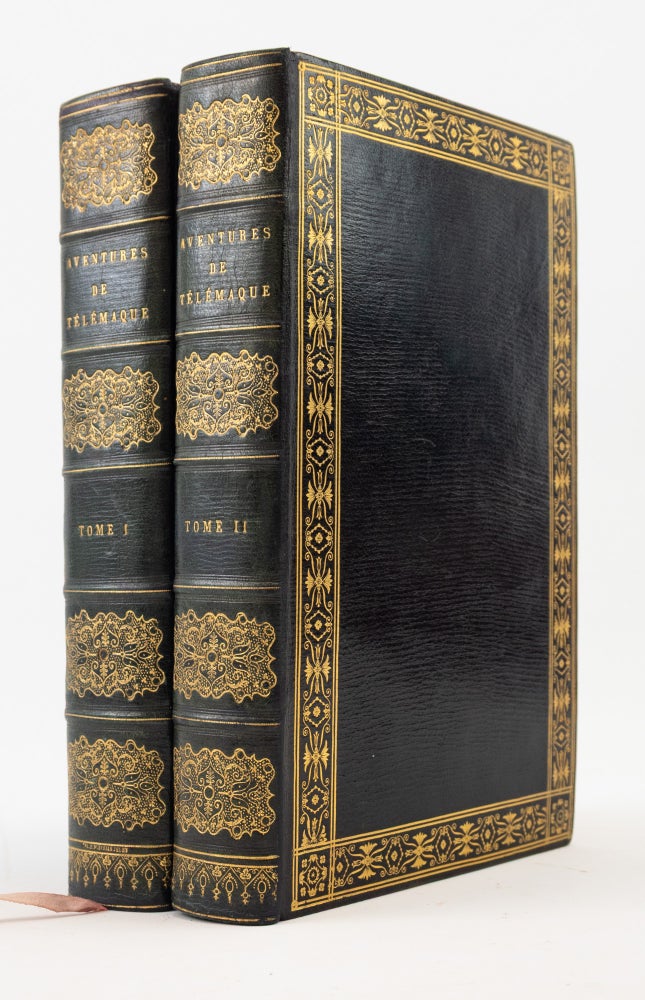
(Paris: De l'imprimerie de Monsieur [i.e., P. Didot jeune], 1790). 243 x 154 mm. (9 1/2 x 6 1/4"). Two volumes.
LOVELY DARK BLUE STRAIGHT GRAIN MOROCCO BY BOZERIAN JEUNE (stamp-signed at foot of Tome I spine), covers with pretty gilt frame enclosed by double gilt rule, raised bands, spine gilt in panels with large millepoint ornament with floral tools emanating from a central circle, gilt lettering, turn-ins with Greek key roll, marbled endpapers, all edges gilt. With frontispiece and six engravings by Cochin and Moreau as called for, all before letters, and EXTRA-ILLUSTRATED with 24 engravings by Marillier, here in proofs before the letter, and with three versions of the portrait of Fénélon by Vivien, engraved by Hubert, Figuet, and Savart. Cohen-de Ricci, col. 386-87 (noting the addition of the Marillier plates to some copies); Graesse II, 565; Brunet II, 1215-16. Spine evenly a little sunned, Marillier plates with minor marginal foxing, isolated small smudges to the (very generous) margins, one quire a little yellowed, a couple of leaves with small holes to a margin due to paper flaws, but AN ESPECIALLY FINE COPY--clean, fresh, and bright, in a most appealing binding with almost no signs of wear.
Our copy of Fénélon's political allegory featuring the son of Odysseus is a very fine example of French Rococo book production, with printing, illustration, and binding by leading practitioners of those arts. Scion of a printing dynasty, Pierre-François Didot jeune (1732-95) sought to improve the family's productions by founding a factory to product the luxurious papers that characterize Didot editions, as well as by making improvements in type-founding to refine their always-admired font. Ray considers illustrators Cochin and Moreau le jeune part of the Rococo pantheon of greats headed by Boucher, Gravelot, and Eisen. He praises Cochin’s "mastery of outline and firmness of composition," as well as his "acute observation and unpretentious humor." Ray was also impressed with Moreau's keen eye for detail, and agreed with the Goncourt brothers that "the grace and charm of his drawing . . . brought about 'a renaissance in the rococo style.'" Forced by financial necessity to take up book illustration, Pierre-Clémént Marillier (1740-1808) soon earned what Ray called "a position in the front rank of book artists" with his skill and energy. Ray deems Marillier "among the most accomplished" illustrators of the century, and he says that "nearly all of his designs are characterized by grace, liveliness, and firmness of drawing”—a fitting description for the plates in our volumes. François Bozerian, generally called Bozerian jeune, was active in Paris from just after the turn of the century until 1818, and for much of that time, he worked with his elder brother Jean-Claude (1762-1840). The Bozerian workshop produced many fine bindings for clients that included the emperor Napoleon I, as well as leading bibliophiles of the day. Their works are valued today especially for their technical achievement and refinement of design. Our two volumes are especially elaborate--even for Bozerian work--and the precision of the faultless finishing here leaves a very strong impression of rigorous order. (ST20479)
Price: $2,400.00