


Browse Similar Items
LA TENTATION DE SAINT ANTOINE DE FLAUBERT.
(Paris: Les Peintres du Livre, 1969). 225 x 215 mm. (8 7/8 x 8 3/4"). [110] pp. No. 129 of 3,000 copies for sale (and 50 hors commerce).
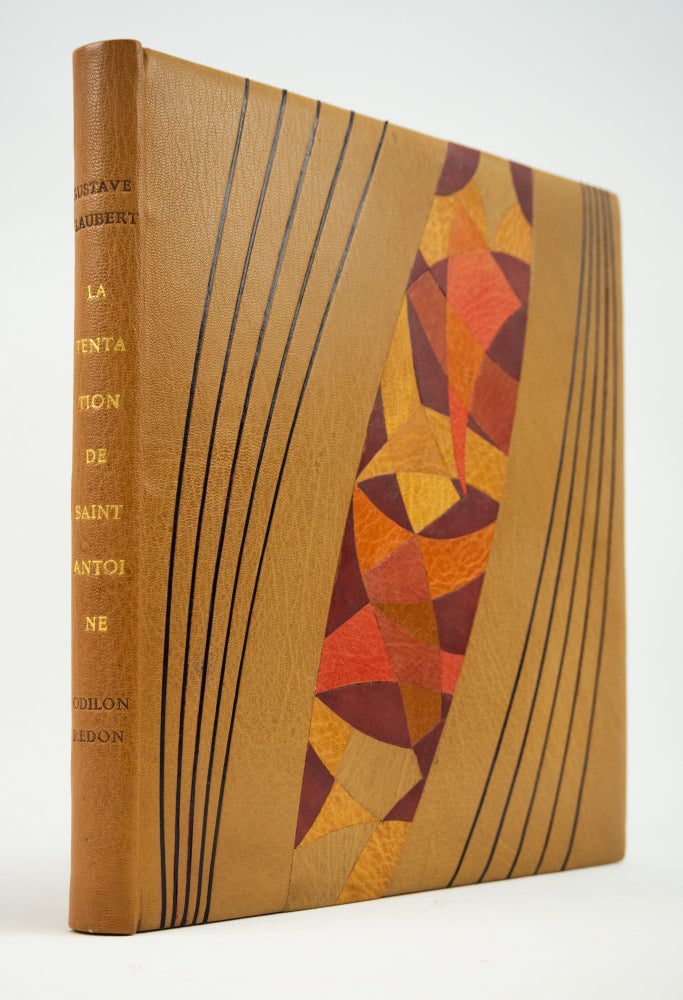
BOLD MOSAIC MOROCCO BY THORVALD HENNINGSEN, tan oasis goatskin with abstract mosaic centerpiece in shades of orange, yellow, and mahogany (suggesting flames), this flanked by five thin, curving black morocco inlaid lines on either side, smooth spine with lettering in gilt and blind, leather hinges, top edge gilt. In the original felt-lined matching morocco-lipped slipcase. Housed in a felt-lined red archival box with paper label reading "174 Henningsen" on one side. With 40 full-page illustrations based on Redon's lithographs. Acquired from the bookbinder's estate, since 2017 in the Hans Burkhardt Collection (Henningsen catalogue raisonnée no. 174). As new.
This ominously illustrated edition of Flaubert's dramatic poem recounting the Devil's temptation of Saint Anthony the Great comes in a handsome binding that pays homage to the legend with an abstract design evoking the shifting sands of the Desert Father's habitat and the flames of desire that tormented him. Flaubert spent more than 25 years writing and rewriting this work, which was finally published in 1874. It recounts one day in the life of the Desert Father who is considered the founder of Western monasticism, a day during which Satan tries to lure him away from God using promises of wealth, power, revenge, carnality, and other forms of indulgence. The "Oxford Companion" calls it "remarkable for its beauty of style and language, and its imaginative power." Symbolist artist Odilon Redon, who had illustrated Stéphane Mallarmé's French translation of Poe, was inspired to create a series of drawings for Flaubert's work. The dark, foreboding lithographs here are early examples of his trademark "Noirs," images first rendered in charcoal and then recreated as lithographs. Redon said of his all-black compositions: "One must respect black. Nothing prostitutes it. It does not please the eye and it awakens no sensuality. It is the agent of the mind far more than the integral part of the artist's fantasy." A Studio International article on the 2006 MOMA exhibit of Redon's work, "Beyond the Visible," notes, "In these early drawings, he developed an easily recognisable repertoire of menacing subjects; these included odd amoeboid creatures, and insects and plants with human heads. Furthermore, there seem to be numerous pictures of severed heads ('Head of St John the Baptist') and it is also evident that he had a fascination in death ('Through the crack in the wall, the head of death was projected')." In her exhibit catalogue essay, Marina van Zuylen places Redon's art somewhere "between the rational and the irrational, norm and deviation, bringing to the public the wonders of the hybrid and the grotesque." Binder Thorvald Henningsen (1896-1977) was apprenticed to Konrad Häsler of Zurich 1910-14, and qualified as a master craftsman in 1921. He managed a bindery in Bern from that time until 1946, when he was able to set up his own workshop in Zurich, where he created beautiful bindings until 1972. His devotion to his craft is encapsulated in this statement: "A book must be beautifully bound not only for the customer's sake, but even more so for the sake of the work itself, for the joy of flawless design." Henningsen made additional contributions to bookbinding through his teaching at the arts and crafts schools in Zurich and Bern, preparing pupils for the master craftsman's examination, as well as his service to the Cantonal Zurich Master Bookbinder Association and the Museum of Bookbinding. Our volume was once owned by Swiss-American Abstract Expressionist Hans Burkhardt (1904-94), who was no doubt attracted to the binding by his fellow Swiss, but likely also to the brooding illustrations of Redon. Burkhardt's own works contemplated death and human tragedy, with art historian Donald Kuspit calling him "a master—indeed the inventor—of the abstract memento mori," and Eugene Anderson declaring him "Goya's spiritual heir." Burkhardt carefully protected the book in an archival box, and it remains as pristine as the day it left the binder. (ST20561)
Price: $8,000.00