


Browse Similar Items
THE MAN WHO DIED.
(Covelo, California: Yolla Bolly Press, 1992). 373 x 262 mm. (14 3/4 x 10 1/4"). 2 p.l., 101, [3] pp.With commentary by John Fowles. ONE OF 35 COPIES BOUND IN VELLUM, 30 of these for sale, OURS ONE OF FIVE RESERVED for the Press (from a total edition of 130 copies, 100 of which were for sale).
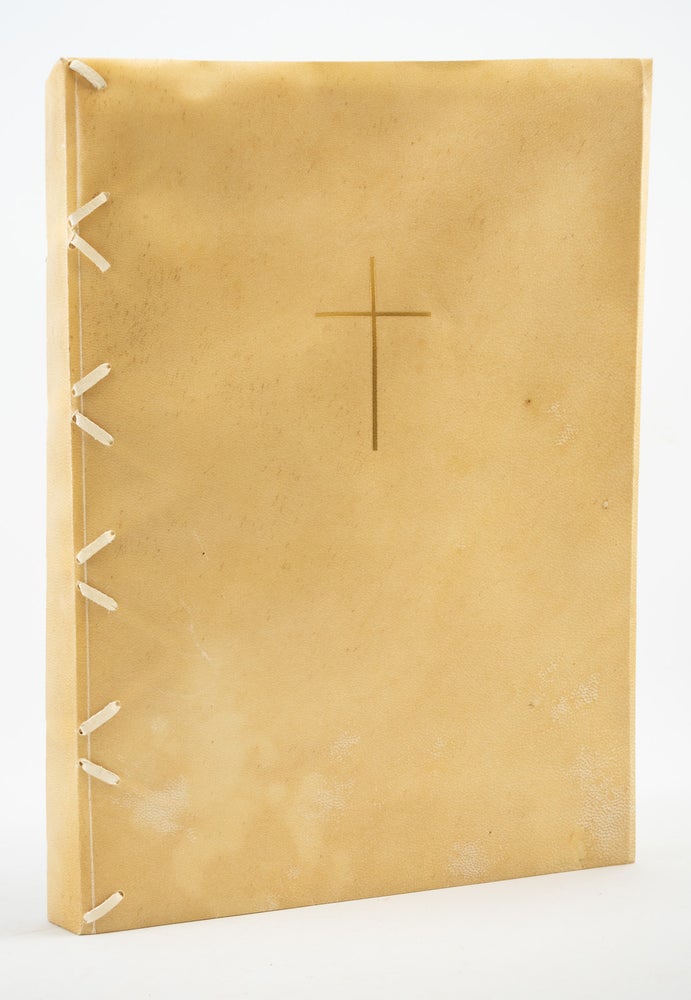
Bound at the press in full vellum by Renee Menge, simple gilt cross on upper cover, white leather stitches along joints. Housed in a bay laurel and cedar wood box with a plain cross carved into the lid. WITH NINE WOODCUTS BY LEONARD BASKIN. SIGNED in the colophon by Leonard Baskin and John Fowles. Anthony Burgess, "Flame into Being," pp. 174-78. As new.
Expressively illustrated by Leonard Baskin, this is one of five Press Copies of an elegant fine press edition of D. H. Lawrence's provocative novella of the Resurrection. David Herbert Lawrence (1885-1930) composed "The Man Who Died" (originally titled "The Escaped Cock") in two sections in 1927-28 as he descended into his final illness. In the novel, a resurrected Jesus embraces humanity and the flesh, turning away from his previous teachings to believe that the body is more important than the spirit. DNB tells us that the book is "a work of intense nostalgia for the body," written by the slowly withering Lawrence. That this openly sacrilegious book did not spark more controversy is surprising; Lawrence biographer Burgess suggests it is due to his care never to explicitly name Jesus in the text, or perhaps because "the whole work is so masterly a piece of prose poetry that it has the capacity to disarm even the faithful." Our edition, with its elegantly simple binding and box, both decorated only with a cross, has not shied away from the connection. From 1983-2001, our publishers, Carolyn and James Robertson, created hand-printed works on the finest handmade paper at their press in Covelo, California, adjacent to the Yolla Bolly Wilderness, from which their press obviously takes its name. As noted in the introduction to "Making Books in the Woods," Stanford University Library's 2002 exhibition of the press' works, "the design of each Yolla Bolly Press book is intimately tied to the nuances of the text, and is completed with great attention to craft. . . . The Press commissions original artwork as well as fresh commentaries by contemporary authors to accompany classic texts, offering an 'interpretation of the original text in a contemporary context.'" The text here is accompanied by commentary from writer John Fowles (1926-2005) and a suite of evocative woodcuts by Leonard Baskin. One of the preeminent American artists of the 20th century, Baskin (1922-2000) considered himself primarily a sculptor, but he is best known for his woodcuts, book illustrations, and the fine books created at the Gehenna Press, which he founded in 1942, while still a student at Yale. His woodcuts and sculptures were in the figurative tradition at a time when abstract expressionism was the dominant movement in art; his defense of his style, quoted in his New York Times obituary, seems especially applicable to the etchings here: "Our human frame, our gutted mansion, our enveloping sack of beef and ash is yet a glory. Glorious in defining our universal sodality and in defining our utter uniqueness. The human figure is the image of all men and of one man. It contains all and can express all." Rugged and emotional, these depictions, like the text, depict a raw and human Jesus, using closely cropped compositions and dark, uneven lines to draw out the visceral celebration of humanity in Lawrence's work. (ST20611)
Price: $4,500.00