


Browse Similar Items
THE SEASONS.
(London: James Wallis, 1805). 230 x 140 mm. (9 1/8 x 5 1/2"). 1 p.l., xx, [8], 286 pp., [3] leaves (index). First Edition Thus.
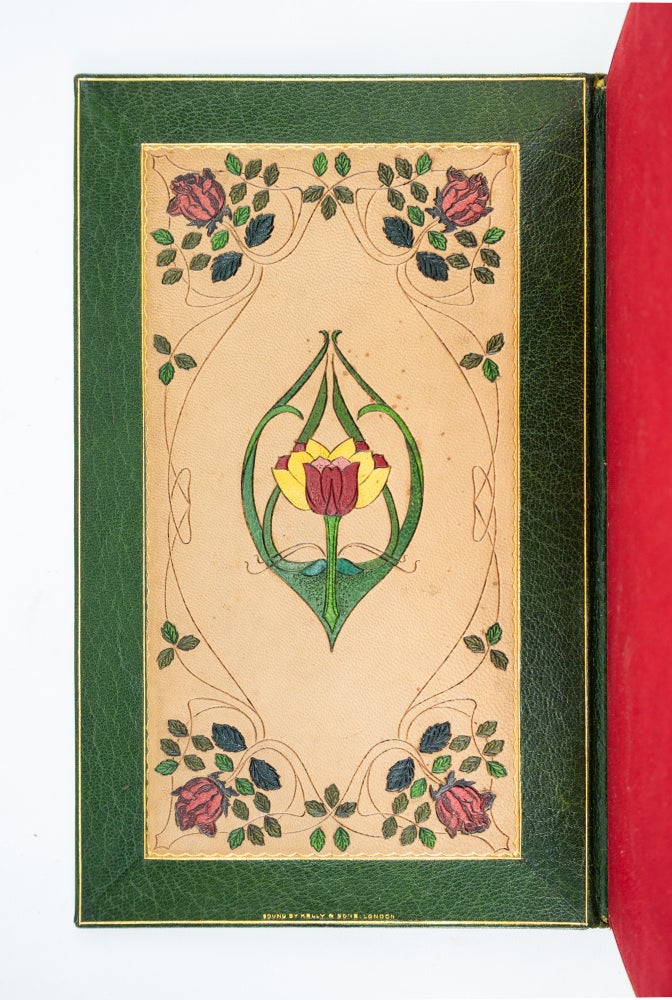
CHARMING EMERALD GREEN MOROCCO BY KELLY & SONS (stamp-signed on front turn-in; stamp-signed "Kelliegram" on rear turn-in), raised bands, spine lettered in gilt, ELEGANT INLAID DOUBLURES of tan morocco decorated with sinuous Art Nouveau vines, floral lozenge centerpieces (tulips at the front and snowdrops at the rear), and bright floral or botanic cornerpieces (roses in front, grapes at rear), the designs composed of many inlays in several complementary colors (featuring various greens as well as intense purple and bright red), scarlet watered silk endleaves, all edges gilt. In a (somewhat worn and faded) custom felt-lined clamshell box. Wood engraved title vignette and NINE CHARMING WOOD ENGRAVINGS BY THOMAS BEWICK. Spine a richer shade of green than the covers, doublures with a handful of tiny light specks, but the binding entirely unworn; internally with intermittent foxing (generally marginal), occasional offsetting or browning from illustrations, otherwise fine, the leaves fresh, bright and smooth.
This is a charming printing--featuring Bewick woodcuts for the first time--of the most influential poem in blank verse from Milton to the Romantics, offered in a lovely binding by a long-lived leading modern English firm. First published in 1730, "The Seasons" was remarkably popular, being found almost universally in English homes, whether cottages or castles, for the better part of a century. Born in Scotland, James Thomson (1700-48) is credited with challenging the artificiality of English poetry and beginning a new era of sentiment for nature. His "Seasons" finds beauty in the wild places, as well as the cultivated fields, and sees in nature the reflection of the creator's bounty. In the present edition, the poem is accompanied by a biography of Thomson and by attractive pastoral scenes engraved by Thomas Bewick. More than any contemporaneous artist or printer, Bewick (1753-1828) was responsible for a renewed interest in wood engraving, having revolutionized it into an art form all its own. The present illustrations, many depicting romantic couples, are executed with Bewick's characteristic depth and delicacy. The contents of our volume are appropriately enhanced by a graceful Kelliegram binding. The firm of Kelly & Sons had one of the longest histories in the London binding trade, having been founded in 1770 by John Kellie, as the name was then spelled. The firm was continued by successive members of the family into the 1930s. William Henry Kelly helped to develop the company in the first half of the 19th century, and he was succeeded by William Henry Kelly, Jr., then Henry Kelly, and finally Hubert Kelly, who took control in 1892. Under Hubert's direction, the bindery became known for its fanciful pictorial elements, although here they are atypically large and found inside, rather than on, the covers. The doublure scenes employ at least 10 different consonant colors of morocco and much incising to give a fine level of detail. (ST20847)
Price: $3,000.00